




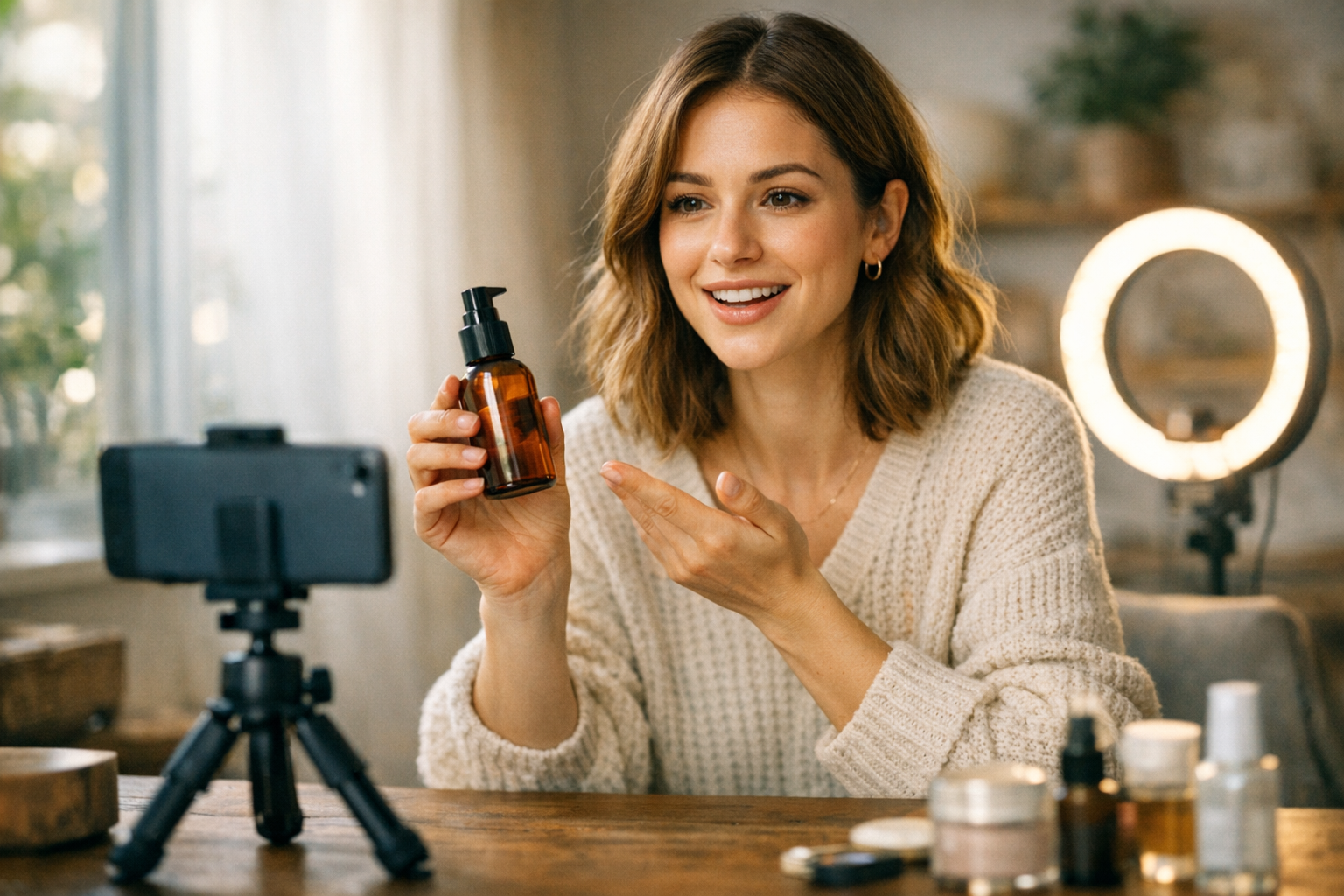
You've got a few thousand złoty for promotion and you keep hearing that influencer marketing is a game for brands with a big-agency budget. That's a misconception that costs small businesses the best results money can buy today for a reasonable price. The creators that big brands overlook because their reach is too small are exactly what a local business or store needs: an audience that actually listens and buys.
In this piece I'll show you the numbers that will convince even your accountant, a realistic starting budget, and the other side of the coin that sellers of influencer packages are reluctant to mention: the obligation to disclose the partnership and to have a contract. You bear legal responsibility together with the creator, so it's not a topic to skip.
The key metric in this industry is the engagement rate (ER), the share of the audience that actually reacts to a post: with a like, a comment, a save or a share. And here's something that surprises many people: the bigger the account, the lower this rate.
Nano creators, i.e. accounts with 1 to 10k followers, reach an ER of 4-8%, and in narrow, niche categories even 8-12%. Macro-influencers, from 500k followers up, drop below 1% (Influee). This isn't a cosmetic difference. It's a chasm between an audience that knows the creator personally and a crowd that scrolls past their content between one ad and the next.
You can see this broken down by platform too. Micro-influencers post an ER of around 4.2% on Instagram and 8.7% on TikTok. The same macro-creators drop to 1.1% on Instagram and 3.2% on TikTok (Cyfrelo). For a small business the takeaway is simple: you're not paying for the size of the account, but for the trust the creator enjoys with their audience. And that trust scales down, not up.
The mechanism is easy to understand. A smaller creator replies to comments, knows some of their audience by name and rarely takes on collaborations, so every recommendation sounds like advice from a friend rather than a commercial. On top of that, platform algorithms reward content that generates a lot of interaction relative to reach, so a nano creator's post with high engagement often travels further than the follower count alone would suggest. You pay little, and the effect can exceed expectations based on account size.
I've gathered the key metrics in a single table. Cost per engagement (CPE) is the price you actually pay for one audience reaction, so it's a better measure of effectiveness than the per-post rate alone.
| Creator type | Reach (followers) | Engagement rate (ER) | Rate per Instagram post | Cost per engagement (CPE) |
|---|---|---|---|---|
| Nano | 1-10K | 4-8%, in a niche 8-12% | 200-800 PLN | the lowest in the comparison |
| Micro | 5-50k | 3-6% (Instagram 4.2%, TikTok 8.7%) | 800-5,000 PLN | PLN 0.80-2.50 |
| Macro | 500k+ | below 1% (Instagram 1.1%, TikTok 3.2%) | usually beyond a small business's budget | 3.50-8.00 PLN |
We checked the prices and rates given in this article in July 2026. Tool pricing and ad auction rates change often, so before deciding, confirm the current terms directly with the provider.
The rate data comes from an analysis of the Polish market (KC Mobile), and the CPE figures from the Cyfrelo report. Pay attention to the last column: for each reaction from a micro-creator you pay between PLN 0.80 and 2.50, and from a macro-star between PLN 3.50 and 8. That means the same effect, a comment from a potential customer, costs you several times more with a macro.
Engagement is one thing, but what you care about is sales. Here too, scale works in your favor. The return on investment (ROI) for micro-influencer campaigns in Poland is 8-11x, while macro campaigns deliver 3-5x. The average ROI of influencer campaigns in Poland is 5.2x (Cyfrelo). In other words, a well-run partnership with a smaller creator can return several times more than the same amount spent on a big name.
It's similar with conversion. The affiliate-link conversion rate - the share of people who actually buy after clicking - is 2.8% for micro creators and only 0.9% for macro (Cyfrelo). More than a threefold difference. A recommendation from someone the audience treats like a friend turns into a sale far more often than a celebrity post that looks like every other ad in the feed.
These numbers only start to make sense once you fit influencers into a broader marketing strategy, rather than treating it as a one-off shot. It's worth planning in advance where, in sales funnel a given collaboration is meant to achieve: whether you're building brand awareness or driving a specific purchase. That determines which creator you choose and what result you have the right to expect.
Now something concrete for a company with a budget of a few thousand złoty. A post from a nano creator costs 200-800 zł, from a micro creator 800 to 5,000 zł (KC Mobile). So for 3,000 zł you can run collaborations with several nano creators at once and test which one resonates well with your audience, instead of spending it all on a single post from a bigger account.
Jest też dźwignia, o której mało kto pamięta: barter. Aż 83% influencerów jest gotowych pracować wyłącznie za produkt, jeśli marka do nich pasuje (Influee). Dla lokalnej restauracji, sklepu z kosmetykami czy studia to oznacza, że próg wejścia bywa bliższy zeru niż wielu przedsiębiorcom się wydaje. Wysyłasz produkt, twórca tworzy treść, Ty zyskujesz autentyczną rekomendację i materiał, który możesz potem wykorzystać dalej.
To put it in concrete terms: with a budget of 3,000 zł you could run, say, five collaborations with nano-creators at 500-600 zł each, instead of a single post on a bigger account for the whole amount. You get five different takes, five audiences, and hard data on which message and which type of creator works best for you. That insight is worth more than reach alone, because you'll plan your next campaign on your own results rather than someone else's promises.
That content is a separate asset in its own right. You can later reuse a creator's good photos and video as creatives in ads on Facebook and Instagram, giving them a second life and a far better return than a single publication. It's also a natural part of content marketing: instead of producing everything yourself, you source content from the market, from people your customers already trust.

Now we get to the part that package sellers skip over, and one that can hurt. Commercial collaborations must be disclosed, and you share liability for a missing disclosure together with the creator.
UOKiK requires commercial content to be clearly labeled at the recipient's very first contact with the post, not somewhere further down the description. Tags like #ad or #collab on their own are not enough (Gazeta Prawna). The correct Polish disclosures are full phrases: “Reklama”, “Materiał sponsorowany”, “Współpraca płatna”. Not abbreviations, not English hashtags squeezed in among ten others (Dikono).
Why is this your problem, not just the creator's? Because liability is joint. The influencer and the brand are jointly responsible for improper labelling, and UOKiK can penalize either party (MDL Kancelaria Prawna). Failing to disclose commercial content qualifies as covert advertising under unfair competition law (Gazeta Prawna). This isn't a theoretical risk, but a real basis for legal proceedings.
How high can the penalties be? Industry analyses report that the maximum administrative fine from UOKiK reaches 10% of a company's annual turnover, while in practice the amounts seen are more like 20,000 to 50,000 PLN. Treat this range as indicative, since it comes from marketing publications rather than official UOKiK materials (Cyfrelo). For a small business, that's the difference between a calm month and a serious problem, so treat disclosing a collaboration as an obligation, not a formality to skip.
A disclaimer I have to state plainly here: this is not legal advice, only an overview of the general requirements. For a real collaboration, run the contract and the labeling method past a lawyer who knows your industry and your specific situation. Regulations and UOKiK's practice change, and your company's liability is on the line.
A handshake and a bank transfer aren't enough. A contract protects both sides and, along the way, settles the disclosure question. A well-structured document should include: the scope of content, a publication schedule, an exclusivity period, copyright to the materials, a clause requiring disclosure of the partnership, a morality clause, verification of the authenticity of reach, and payment terms (Cyfrelo).
Pay particular attention to two points. Copyright determines whether you'll be able to legally use a creator's photos in your ads, which I wrote about above. Verifying the authenticity of reach protects you from paying for bought followers who will never buy anything.
The cost? A one-off spend on a contract template covering copyright and UOKiK requirements is PLN 1,500-3,000 (KC Mobile). You pay once and use the template for every future collaboration. On a budget counted in the thousands, it's an investment that pays for itself the first time you avoid a problem and the first time you get a piece of material you can legally reuse.
Before you pay, vet the account. Compare the follower count with the number of likes and comments on recent posts: if an account has tens of thousands of followers but only a dozen or so reactions per post, something is off and you'd probably be paying for a dead audience. Look into the comments and check whether they're real conversations or repetitive emojis from the same profiles. Also pay attention to how the creator disclosed past partnerships, because that immediately shows whether they understand the requirements and won't drag you into a disclosure problem.
Finally, ask for the statistics from the creator's dashboard, especially the real reach and audience breakdown - that is, age, gender, and location. If you sell locally, an account with an audience scattered across the country or abroad won't do much for you, even with great engagement. Later, write the obligation to share this data into the contract as the reach-authenticity verification I describe below.
Before you send your first message to a creator, get the basics straight. Define who your customer is and which creator reaches them, because topical fit matters more than follower count. To find and pre-screen profiles you can use artificial intelligence tools in marketing, which speed up reviewing hundreds of accounts and catch inconsistencies in the statistics.
Match the platform to what you sell, too. TikTok delivers higher engagement, especially among younger audiences and for products that look good in short video. Instagram works better for aesthetics, fashion, interiors or food, where the photo and the mood matter. The same amount spent on the wrong platform will bring a weaker result even with a good creator, so treat the choice of channel as seriously as the choice of person.
Also take care of what the audience finds on the other side of the link. If someone clicks and lands on a profile or page without a consistent visual identity, the trust built by the recommendation evaporates in a second. A recommendation draws attention, but it's your brand that has to hold that attention and turn it into a purchase.
In short: for a small business, nano and micro creators beat macro on every metric that actually translates into money - engagement, cost per reaction, conversion, and return on investment. The barrier to entry is lower than it seems, because most creators will accept barter. The only thing you must not skip is the contract and the disclosure of the collaboration, because you'll pay for a mistake together with the creator.
For a business with a budget of a few thousand złoty, nano creators (1-10k followers) and micro creators (5-50k) work best. They achieve a higher engagement rate, a lower cost per interaction, and better conversion than large accounts, and their rates - from 200 to a few thousand złoty per post - fit a realistic budget. What matters is the creator's fit with your audience, not the size of the account itself.
Yes. UOKiK requires clear labeling of commercial content from the audience's very first contact with the publication, using full phrases such as “Advertisement”, “Sponsored content” or “Paid partnership”. Hashtags like #ad or #collab alone are not enough. Liability is joint, so both the creator and your company can face a penalty. This is a topic where it's worth consulting a lawyer before you start.
A post from a nano creator costs 200-800 zloty, from a micro creator 800-5,000 zloty. On top of that comes a one-time cost for a contract template covering copyright and UOKiK requirements, i.e. 1,500-3,000 zloty, which you then reuse many times over. It's worth remembering that as many as 83% of creators are willing to work for product alone if the brand suits them, so barter genuinely lowers the cost of entry.
The numbers speak clearly. The return on investment for micro-influencer campaigns in Poland is 8-11x, versus 3-5x for macro, against a market average of 5.2x. The affiliate-link conversion rate is 2.8% for micro and only 0.9% for macro. Smaller reach means a closer relationship with the audience, and that translates into sales more effectively than a large but anonymous account.