






The customer types into their phone hairdresser near me and in a fraction of a second sees three businesses. Not ten, not a whole page of results. Three. That block at the top of the screen, right above the map, is the Local Pack, the set of three businesses that Google shows at the very top of the results for queries with local intent (lokal360.pl). Dla warsztatu, kancelarii, gabinetu czy salonu to nie jest dodatek do pozycjonowania. To jest pozycjonowanie.
If you're only just piecing the whole topic together from scratch, start with our guide on what website SEO is and how much it costs. We won't repeat the general principles of SEO here. We'll deal only with what's local, because competing for a customer from the neighborhood follows a different set of signals than competing for a position nationwide.
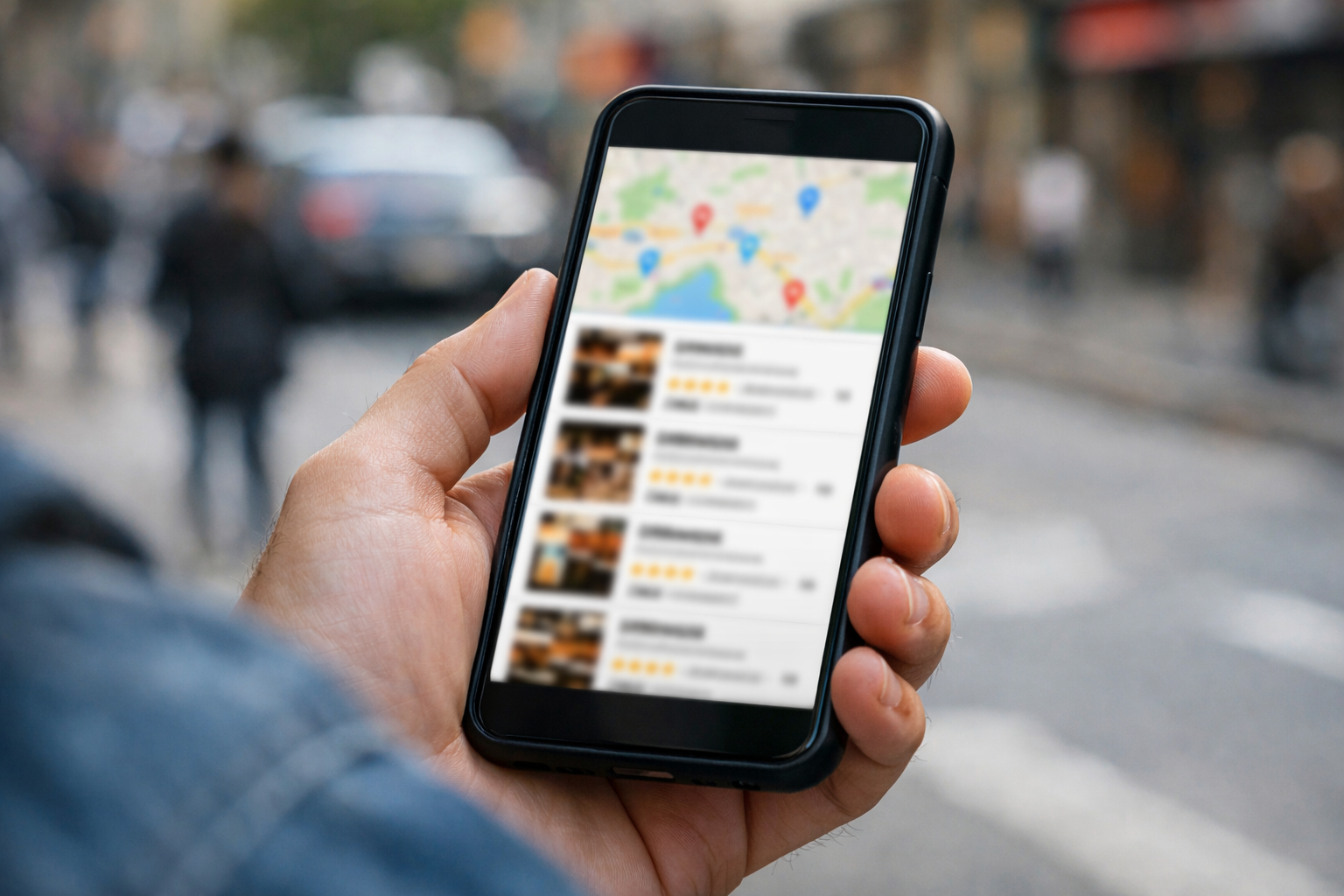
Before a customer reaches your website, they first pick from three tiles. 45% of consumers start a local search on Google by default, and another 15% go straight to Maps. So the first contact with your business almost never begins on your website. It begins in Google's results, in the same Local Pack where your competition sits.
The Local Pack shows three businesses with a name, star rating, opening hours and a navigation button. Whoever is in that trio gets the phone call. Whoever is fourth is hoping someone expands the full list. The difference between third and fourth place is, in practice, the difference between a full and an empty schedule next week. And that's exactly why local SEO is worth treating as a separate discipline, not a footnote to classic search optimization.
It's also worth remembering where these queries come from. A large share of local searches happen on a phone, on the move, with a readiness to act immediately: to call, set a route, walk in. This isn't someone who spends a week comparing offers. It's someone who needs the service now and will pick one of the three companies in front of them. Your job is simply to be one of those three.
Local business owners still think of SEO as a fight for their website's position. In local search, the most important asset is different: the Google Business Profile (GBP for short), the free business listing that appears in the Local Pack and on Google Maps.
It's the profile, not the website, that is the main lead generator for a local service business. A website is still needed, because it builds credibility and closes the sale (if you're wondering how much a website costs, that's a separate topic). But it's the profile that fields the first inquiry, the first phone call and the first mapped-out route to your door.
And here's the best news for you: your competitors neglect this profile. Only 35% of small and medium businesses (SMBs) even have a Google Business Profile set up, and of those that do, a full 56% haven't fully optimized it (data from biziq.com). This isn't a market where you have to outclass someone. It's a market where most rivals simply never made it to the starting line. The cheapest advantage in a local market isn't an ad budget - it's the work your competitors haven't done.
Since the profile matters most, it's worth knowing what specifically influences whether Google shows you in that trio. The 2026 Whitespark survey, which involved 47 local SEO experts, weights the ranking signals roughly as follows (w3marketinghub.com):
The weights below come from an expert survey, not from official Google documentation. Treat them as a direction for where it's worth investing your time, not as an exact formula.
| Ranking signal | Estimated weight |
|---|---|
| Google Business Profile (completeness and activity) | 32% |
| On-page SEO (your website) | 19% |
| Reviews (count, rating, recency) | 16-20% |
| Inbound links | 15% |
| Behavioral signals (clicks, calls, routes) | 8% |
| Directory citations (citations) | 7% |
One signal, the Google Business Profile, carries almost as much weight as the next two combined. This is your map of priorities. Not a fifth business directory, but a complete, living, regularly updated profile. Citations, meaning mentions of your business in directories, round out the list with a weight of 7%, which doesn't mean they're meaningless, as we'll see in a moment.
There's one more factor that overshadows this whole table: proximity, the physical distance between the customer and your business at the moment of the search. It accounts for around 55% of ranking decisions in local results. It sounds overwhelming, but there's a catch: you don't control proximity. You can't move your office closer to every patient.
So proximity isn't an excuse - it's a reason to squeeze the most out of everything you control. Since more than half of the equation is locked, your visibility comes down to how you play the rest: your profile, reviews, and data consistency. A competitor right next to the customer will win the queries on their own doorstep. But within the radius where you're both in the game, the better-managed profile wins, not the one that merely exists.

Reviews are the second pillar of local visibility and, at the same time, the fastest lever you have. They work on two fronts: they convince the algorithm and they convince the human.
Let's start with the human, because here the numbers are merciless. 97% of consumers read reviews of a local business before choosing it. What's more, the bar is rising: 68% of consumers now expect a rating of at least 4.5, whereas a year earlier 55% did (christopholivierconsulting.com). A rating of 4.3 was fine not long ago. Today it cuts you off from two-thirds of the market before anyone even calls.
The algorithm sees it similarly. Businesses with 50 or more reviews and an average of 4.5+ consistently dominate the Local Pack (inclick.pl). And it's not about the rating alone. A profile with a perfect five off just five reviews raises Google's suspicions, because that distribution looks rigged. What's safe and credible is a 4.5+ level built on a real number of reviews, not an artificial 5.0 from a handful of entries.
The most important thing is that reviews work fast. Increasing their number from 30 to 100 yields, on average, a jump of 2-3 positions in the Local Pack within 4-6 months (seotrade.pl). For a business sitting in fourth place, that's exactly the jump that moves it into the visible top three. Asking for a review after a job well done, a short link sent by text, a QR code on the counter: this isn't a sophisticated strategy, it's a habit that turns a satisfied customer into a hard ranking signal.
In practice, simplicity works best. Pick one moment when you ask for a review - for example, right after a customer picks up their car from the workshop or after a completed appointment at the clinic - and stick to it every time. Prepare a short, ready-made link for leaving a review so the customer doesn't have to search for anything. Respond to reviews too, including the weaker ones: a calm, matter-of-fact reply to criticism builds trust with future readers more effectively than a high average alone.
NAP stands for Name, Address, Phone - your company's name, address, and phone number. It sounds trivial, yet it's one of the most neglected elements of local SEO. Google cross-references data about your business from dozens of places online: your profile, website, industry directories, maps, and social media. If one place lists 3 Kwiatowa Street, another lists 3 Kwiatowa St., unit 1, and a third has an old phone number, the algorithm loses confidence that it's the same business. And less confidence means a lower ranking.
More counts as inconsistency than you'd think: a different spelling of the name (once with the sp. z o.o. suffix, once without), the ul. abbreviation that's there one time and gone the next, two different phone numbers left over from switching operators, an old address that lingered after a move. To the algorithm, each such variant is a separate doubt, and doubts add up.
The scale of the problem again works in your favor. 64% of small and medium businesses have inconsistent NAP in at least one major directory. It's the same pattern as with the profile: most of the market shoots itself in the foot, and you can fix this in a single afternoon. Profiles with consistent NAP across the top 50 directories rank on average 2.4 positions higher. Two and a half positions for something that's ordinary housekeeping and requires neither budget nor talent.
Until now, NAP consistency was a matter of classic ranking. In 2026 a second, far sharper reason to sort it out arrived. Google increasingly answers local queries generatively, in AI mode, serving up a ready answer instead of a list of links. And here data consistency stops being a question of position and becomes a question of being in the answer or not existing in it at all.
The available data shows that businesses with inconsistent NAP across three or more sources are left out of local answers generated by Google's AI mode in 74% of cases (biziq.com). In other words: if your data doesn't match, the algorithm would rather not mention you at all than risk giving a wrong address. For a local business, that means one thing: your data has to be boringly consistent, identical everywhere, so that no system, classic or generative, has any reason to skip you.
This trend is only just emerging and shouldn't be treated as a certainty, but the direction is clear. More and more people search for local businesses beyond Google alone. Around 45% of consumers already turn to ChatGPT or other generative AI tools to find a local service. These systems also draw on how consistently and credibly your business is described across the web. A tidy profile and consistent NAP are today not only about your position in the Local Pack, but also a ticket to being considered by the machine at all. It's a good time to start thinking about visibility in terms of a consistent marketing strategy, not isolated, random fixes.
You don't have to do everything at once. The order follows directly from the weights you saw in the table:
Once the local foundation is in place, it's worth adding paid reach to speed up the effect. For a local service, a good combination is Google Ads for queries with buying intent and Facebook and Instagram ads that builds recognition in your area. Paid and organic don't compete with each other, they complement each other: advertising brings traffic right away, while your profile and reviews build a position that lasts.
The profile handles first contact: it's what lands in the Local Pack and on Maps, and it's what most often triggers a phone call. The website closes the conversion and builds credibility, and its on-page SEO accounts for about 19% of local ranking. They work best together: the profile attracts, the website persuades. Starting from scratch, nail the profile first, because it delivers a faster return.
There's no hard threshold, but the data is fairly clear. Businesses with 50 or more reviews and an average of 4.5+ consistently dominate the Local Pack. Going from 30 to 100 reviews yields, on average, a jump of 2-3 positions within 4-6 months. Treat 50 as your first realistic goal, and 4.5+ as the bar you hold to permanently.
Completing your profile and unifying your NAP can produce results within weeks, because these are signals Google processes quickly. Building up reviews is a 4-6 month horizon for a noticeable rise in the Local Pack. This isn't a campaign you switch on and off, it's a foundation that works harder over time.
Not directly, because proximity (the customer's distance from your business) can't be shifted. But that's exactly why the rest matters. Since about 55% of the decision is beyond your control, the outcome for the remaining part comes down to a complete profile, strong reviews and consistent NAP. You won't capture customers right on your competitor's doorstep anyway, but the whole zone where you're both in play is won by the better-run business.