

Google Business Profile SEO: what actually moves a business up in Maps
In brief
- Results in Maps are based on relevance, distance, and prominence. Google says plainly that a better position cannot be ordered or bought.
- You cannot change distance without changing your address. The category, the service list, and the description are one evening's work.
- 97% of people surveyed read reviews of local businesses, and 41% always check them (BrightLocal, February 2026).
- The seven day plan is about seven hours of work. Day two (services) and day six (reviews) give you the most.
- Measure calls and direction requests in your profile statistics, not the position you see on your own phone.
Google Business Profile SEO means working on the three things Google takes into account in local results: how relevant your profile is, how far you are from the person searching, and how prominent your business is. Two of these factors are up to you and can be improved within a week; the third one you cannot change without changing your address. Below you will find a checklist of these factors and a plan in which a small business owner does most of the work alone.
The three factors behind Google Business Profile SEO
Google describes it without beating around the bush: local results are based mainly on relevance, distance, and prominence, and a better position cannot be ordered or bought (Google's guidance on local ranking). Anyone who promises you the top spot in Maps is promising something they do not control.
| Factor | What Google builds it from | Your influence | When you see the effect |
|---|---|---|---|
| Relevance | Categories, services, description, attributes, website content | Almost full | A few days |
| Distance | Distance to the person searching | Only through your address and service area | Not applicable |
| Prominence | Reviews, ratings, mentions, and links about the business | Indirect, through your service and asking for reviews | A few months |
Relevance: does Google understand what you do
Relevance is how well your profile matches what a person is looking for. Google builds it from your primary category, your additional categories, your service list, the description, the attributes, and the content on your website. If your category is “Construction company” while customers search for “home insulation,” your profile may never reach those results.
The simplest test: write down five queries you believe your customers type, and check whether each one has a counterpart in a category, a service, or the description. The gaps are your to do list. If you want someone to run this for you on an ongoing basis, the service for that is local SEO and Google Business Profile management.
Distance: the one factor you cannot get around
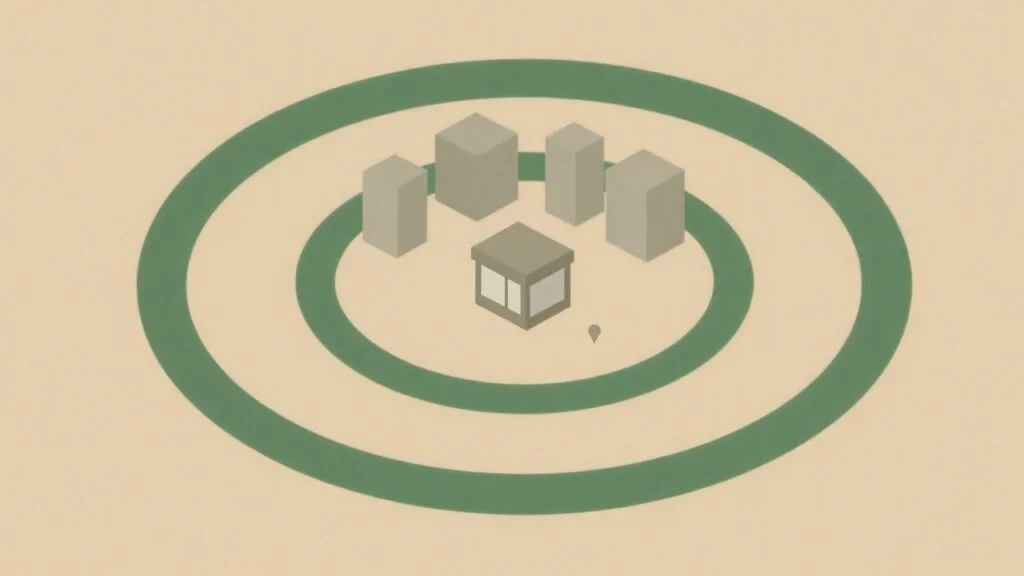
Distance is how far you are from the person searching. If someone does not share their location, Google estimates it from what it knows about them. That is why the same hairdresser is first for someone on the same street and invisible to someone on the other side of town, with an identical profile.
The practical takeaway: do not compare your position with the one you see on your phone while sitting in your own shop. Check the results from the neighborhoods you really want customers from, and do not count on reaching the top spot in a city where you have no address.
Prominence: how much Google knows about you from other places
Prominence is how well known your business is, built among other things from the number of reviews, the ratings, and links to your business online. This is the most tedious part, but also the only one where steady work every month visibly changes the picture. Reviews collected evenly over a year work better than forty reviews in one week, because a sudden burst looks suspicious both to Google and to a customer reading the dates.
How to rank your Google Business Profile in a week: a concrete plan
This plan assumes the profile already exists and is verified. If you are starting from scratch, first go through setting up a Google Business Profile step by step, because an unverified profile has nothing to rank.
- Primary and additional categories. You check which categories are used by the three businesses sitting above you in Maps, and fix yours. About 45 minutes.
- A service list with your own descriptions. You do not leave Google's suggested services without any text; you describe every service in the words a customer uses on the phone. About 1.5 hours.
- Business description, service area, attributes, and hours. You fill in the hours together with the holiday dates for the next six months. About an hour.
- Photos. The interior, the entrance from the street, the team, finished work, all shot on a phone the same day. About an hour.
- A consistent name, address, and phone number. On your website, in Maps, and in industry directories, written exactly as on your invoices. About 1.5 hours.
- A review link and a request to your last five customers. Plus a QR code on the counter or on a flyer tucked into the receipt. About 45 minutes.
- A record of your starting point. The number of reviews, the average rating, and the profile statistics in a spreadsheet, so that in a month you have something to compare against. About 30 minutes.
Seven tasks, about seven hours of work. Most of the effect comes from steps two and six, so if you only have time for two, do those.

Business name: the most common way to lose your profile
Adding services, a city, or advertising slogans to your business name looks like a free advantage and is the fastest route to a suspended profile.
Note
Google prohibits marketing slogans, store codes, opening hours, phone numbers, website addresses, and information about services and location in a business name (guidelines for representing your business on Google). Getting a suspended profile back means a reinstatement request and another round of verification, not a single click.
The name field is for the name you have on your sign, on your invoices, and on your website. “Plumber Olsztyn 24h Cheap” is not a name, it is an ad written into a field where ads are not allowed. If you see a competitor doing this and ranking higher, you can report a name correction instead of copying their risk.
Reviews: rhythm instead of a sprint, and limits you must not cross
How much reviews weigh
In BrightLocal's study from February 2026, 97% of people surveyed read reviews of local businesses, 41% always check them, and the average customer looks at six different review sites. 71% named Google as a place where they read reviews, down from 83% a year earlier. Maps is still the first stop, but not the only one.
Source: BrightLocal, Local Consumer Review Survey 2026, 11.02.2026
Reviews feed into prominence, so collect them with a system instead of whenever it happens to come up. A system means one sentence of a request at the end of every job, sent through the same channel you use to talk with the customer, plus a ready made short link for leaving a review and Google review QR code printed at the register.
What you must not do, because Google treats it as fake content and punishes it with profile restrictions, up to hiding your reviews (Google's prohibited content policy):
- discounts, freebies, or any other benefit in exchange for a review,
- selectively asking only satisfied customers and discouraging negative reviews,
- setting review quotas for employees or requiring the customer to name an employee in the review,
- pressuring the customer to leave a review while still on site,
- reviews posted by one person from several accounts.
Reply to reviews, the good ones too, briefly and to the point. This is one of the few things you do in public that are read both by Google and by the next customer comparing you with three other businesses.

Profile freshness: photos, hours, replies
A profile that has not changed in two years looks closed. Once a week, post two or three photos from ordinary work: a finished job, the interior, the stock that just arrived. A phone is enough, you do not need a photo shoot.
Keep an eye on your opening hours around every holiday and every vacation break. A customer who drives up to a locked door during the hours listed in Maps leaves a review that no amount of optimization will undo.
One thing has changed enough here that you need to know about it. Google shut down the questions and answers API on November 3, 2025 and is retiring the public Q&A section from profiles. In its place, Maps now has Ask Maps, a chat with answers composed by Gemini: it launched on March 12, 2026 in the US and India, and in August Google expanded it to more than 150 countries, in English for now. So customers read your answers to questions less and less often, and more and more often receive text assembled from your service descriptions, your profile data, and your reviews. Those are the material for the model, so write them as if someone were going to turn them into a summary of your business. For a wider view of how to do this, see the post on visibility in ChatGPT and Google AI Overviews.
How to check whether it's working at all
Measure calls and directions, not position. Your profile statistics show the number of calls, clicks through to your website, and direction requests, and those are the numbers that talk about money. Write them down once a month in a spreadsheet, because Google only shows a limited range of history.
Example
An example calculation you can run on your own data: 40 people a month call from the profile, one in four calls ends in a job, and the average job is PLN 500. The profile then brings in about PLN 5,000 of revenue a month. Plug in your own numbers, and only then decide how much it makes sense to spend on this part of your marketing.
If that time is going to cost someone other than you, on our side it splits into two things.
PLN 600 one time cleanup and optimization of your Google Business Profile
PLN 1,490/month the Local SEO package, meaning ongoing work on your visibility
With one location and one city, the first option is enough to start. The monthly package makes sense when you have several locations, competitors with hundreds of reviews, or nobody to keep an eye on the profile.
What Google Business Profile SEO will not do
It will not make you visible across a whole region if you have one address in one neighborhood. It will not get you past a lack of reviews when a competitor has been collecting them for five years. It will not work in a week, because some of the signals (reviews, links, photos) build up over months.
What it does do is work faster and cheaper than most other channels for a service business with a single location, because it reaches people who are already looking for what you sell and are nearby. It is a good place for your first marketing money, before you start thinking about ads.
If you want to know which of these factors look weakest in your case, order a free audit or call 511 608 362 Monday through Friday between 10 a.m. and 6 p.m.
Frequently asked questions
How long does Google Business Profile SEO take?
Google picks up profile edits (categories, services, description, photos) within a few days. Work on prominence, meaning reviews and mentions of your business, usually shows after a few months of steady collecting, because it is a signal that builds up rather than a switch you flip.
Can a profile rank high without a website?
It can, because local results are counted separately from the results with links to websites. What you lose is the place where you describe your services in your own words, and one of the sources Google uses to confirm information about your business. A simple page with a description of your services and the same address and phone number as in Maps is usually enough.
Why is a competitor with a more distant address above me?
Usually they have a better chosen primary category, more reviews, or more mentions online, and those factors can outweigh a worse distance. Check the category first, then the number and dates of the reviews. Remember too that the results you see on your own phone and the results seen from another neighborhood are two different lists.
Will adding the city to my business name help?
No, it breaks Google's guidelines and risks getting your profile suspended. You give the city and your service area in the address and service area fields, and for the name you use the one on your sign and on your invoices.
Is it worth paying for a position in Maps?
There is no such option. Google says plainly that a better position in local results cannot be ordered or bought. The only paid option is ads in Maps, labeled as ads, and that is a completely different mechanism from local ranking.